Dryers
Dryer thermal fuse keeps blowing: find what is overheating it
A dryer thermal fuse that blows again and again is a symptom. Crawl-space vents in older houses, stuck thermostats, grounded elements and slipping blowers.
Gas & electric dryers · Mill Creek
Gas heats most homes in and around Mill Creek, so plenty of laundry rooms here hold a gas dryer. We repair gas and electric models, check the long vent runs common in newer townhomes, and keep the safety rules plain.
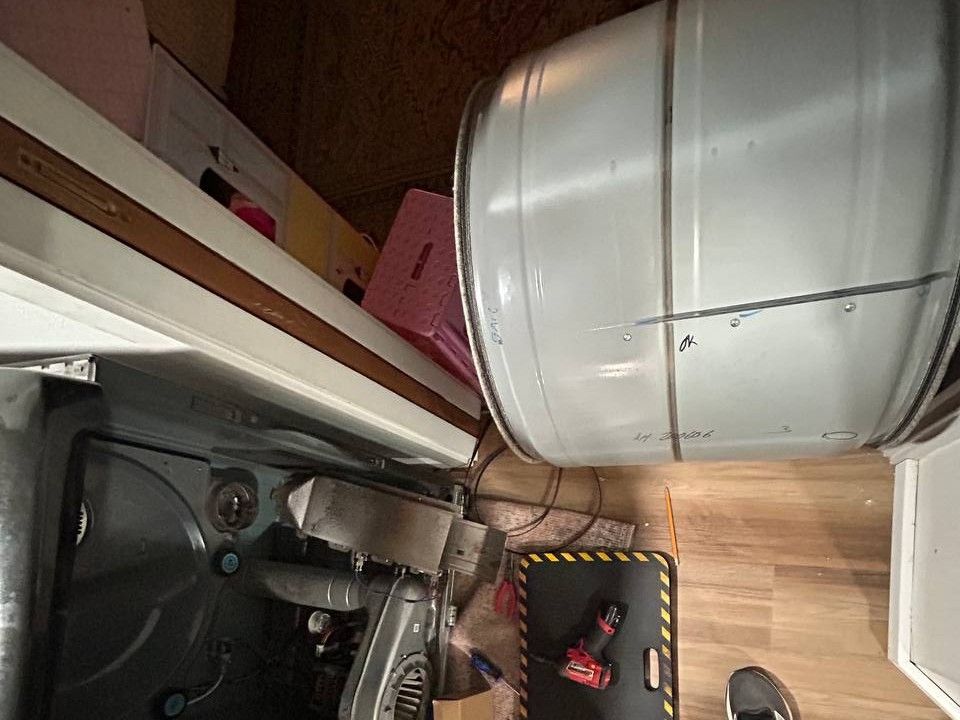
A house with PSE gas already piped in for the furnace usually got a gas stub in the laundry room as well, and in Mill Creek that describes most homes. Gas dryers fail in their own way. The drum turns, the timer counts down, and the clothes stay damp because the igniter has weakened or the two small coils on the gas valve no longer open it reliably. Silver Firs, where about seven homes in ten heat with gas, and Mill Creek East, at close to two in three, send us more gas dryer calls than almost any other part of our area.
Electric dryers fill in the rest: the apartments and townhomes around Town Center, East Gateway and The Farm, plus houses whose owners went electric when they replaced a machine. Their failures are elements, thermal fuses and cycling thermostats, and nearly all of them trace back to airflow. A dryer that cannot push its moist air outside quickly runs hot inside, blows its safety fuse and eventually burns out its element. We carry the common parts for Whirlpool, Maytag, LG, Samsung, GE, Electrolux and Speed Queen dryers, so most of these visits end with the machine drying again. The few that cannot finish on the spot usually wait on a board or a model-specific motor, which we order and install on a short return trip.
What you seeGas dryer tumbles but the clothes stay cold
Likely causeIgniter cracked or too weak to open the valve
What we doTest the igniter and flame sensor, replace the failed one and watch a full burn
What you seeBurner fires, goes out, then stays cold
Likely causeCoils on the gas valve weakening once they heat up
What we doReplace the coil set and run several heat cycles to confirm
What you seeElectric dryer runs with no heat at all
Likely causeOpen heating element or blown thermal fuse
What we doMeasure both, replace the failed part, then find what overheated it
What you seeTowels need two or three cycles
Likely causeLint packed in a long vent run or a crushed transition duct
What we doCheck airflow at the outside hood, clear the run and fit a sturdier duct
What you seeA rhythmic thump or a high squeal with every turn
Likely causeWorn drum rollers, idler pulley or a frayed belt
What we doReplace rollers, pulley and belt together on a worn machine
What you seeStart button does nothing at all
Likely causeOpen door switch, thermal fuse or belt switch, or a dead outlet
What we doTest the outlet first, then each switch in the start circuit
Vent length is the big local variable. In a detached house in Mill Creek East the dryer usually sits against an outside wall and its exhaust travels a few feet to a hood. In the townhomes and apartment buildings near Town Center, laundry closets sit deep in the floor plan, so the duct turns corners inside walls and ceilings before reaching a roof cap or a side wall two stories up. Every bend adds resistance and catches lint, and packed lint near a hot dryer is a fire risk as well as a slow-drying one. We measure airflow where the air actually leaves the building, not only behind the machine, and replace crushed foil connectors with semi-rigid metal. If the hidden run needs more cleaning than we can reach, you hear that from us directly.
The original plat houses from the late 1970s and 1980s add an electrical wrinkle. Dryer receptacles from that era were usually three-prong, while many newer dryers arrive configured for a four-wire cord. A cord fitted wrong, or a receptacle scorched by years of loose contact, can cause no-heat faults that mimic a bad element. During the diagnostic we test the outlet and the voltage at the dryer's terminal block, and we replace the cord or terminal block on the appliance side when that is the trouble. Wiring inside the wall or at the panel belongs to an electrician, and we say so when that is where the fault sits.
Gas brings one rule that comes before any repair. A gas odor near the dryer outranks every repair: leave the controls, switches and plugs untouched, walk the family out to the street, and phone PSE or 911 from there. PSE deals with the odor on its side, and we come once the line is cleared. On routine gas jobs, your technician checks every connection we loosened with a leak-detection solution before packing up.
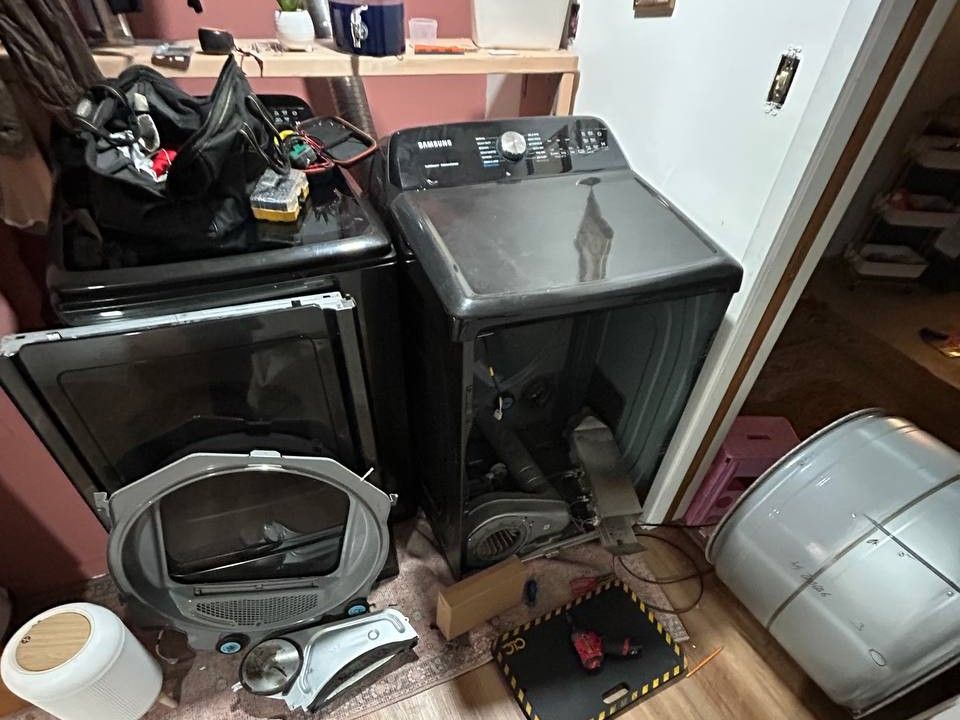
Dryer repairs in Mill Creek start from $229, the low end of a category that runs from vent clearing and thermal fuses up through igniters and boards. None of the figures in the table is a quote for your dryer. Your technician finds the cause during the $95 diagnostic, puts an exact figure in writing, and starts only after you approve it, at which point the diagnostic is credited to the job. If you would rather not proceed, you pay the diagnostic and nothing more.
| Blocked vent cleared to the outside | from $229 |
|---|---|
| Thermal fuse or cycling thermostat | from $229 |
| Heating element (electric) | from $239 |
| Drum rollers, idler pulley, belt | from $239 |
| Igniter and gas valve coils | from $249 |
| Control board | from $259 |
| Diagnostic visit | $95, counted toward the repair |
| Another appliance on the same call | $10 off its diagnostic |
2026 starting prices for Lynnwood and nearby towns. The $95 diagnostic counts toward any repair you approve, and your technician writes the exact figure down before work begins.
Few household machines are as mechanically plain as a dryer, and nearly everything that wears out on one, from igniters and coils to fuses, elements, rollers and belts, costs far less to fix than to replace. We lean toward buying new only when the drum has rusted through, the cabinet is coming apart, or an electronic control dies on a dryer that has already given many years of service. The hookup matters here too. A gas dryer in a Silver Firs laundry room can only be swapped for an electric one if a 240-volt circuit is already there, and going the other way needs a gas line, so repairing the current machine keeps you on the connection you have. In the stacked closets of the newer rental buildings, a replacement has to match the washer below it and fit the opening, which often makes repair the simpler choice.
Usually it just fails to heat: the igniter cannot get hot enough to open the gas valve, so no gas flows. It wastes time and power rather than creating a hazard. The exception is any smell of gas. If you notice one, stop, leave the house and call PSE or 911 from outside. Otherwise, book a visit and dry small loads on air fluff until we arrive.
Clean the lint screen, start the dryer on high and go outside to the vent hood. The flap should open wide and you should feel strong, warm air. A weak puff, a flap barely moving or lint around the hood points to a restriction. In townhomes with roof vents you may not reach the hood; your technician checks it from inside with an airflow meter.
Either the dryer has a short, often an element touching the cabinet or a burned terminal block, or the circuit itself has a fault. Reset the breaker once; if it trips again, leave it off. We test the outlet and the dryer's internal parts and fix anything inside the appliance. If the breaker, receptacle or wall wiring is the cause, we tell you an electrician is needed.
Yes. Stacked units are common in the Town Center, East Gateway and Farm buildings, and the dryer section uses the same igniters, elements, fuses, belts and rollers as a standalone machine. We pull the unit from the closet, make the repair and set it back level. Mention the closet size when booking so your technician brings the right moving gear.
Whirlpool and Maytag lead, followed by LG, Samsung, GE and Electrolux, with a few Speed Queen machines in houses that bought for durability. Many builder dryers from the 2000s are Whirlpool-made models sold under several names, and their igniters, rollers and fuses ride in our vehicle. The model number sits on a tag around the door opening; read it out when you call or enter it on the form.
Something not working?
Book online or call (425) 287-5458; a morning call leaves the most room for a same-day dryer visit. Whatever the $95 diagnostic finds, that fee rolls into the repair you agree to, and veterans, active-duty military families and seniors 65+ can take up to $18 off it.
Dryers
A dryer thermal fuse that blows again and again is a symptom. Crawl-space vents in older houses, stuck thermostats, grounded elements and slipping blowers.
Book a repair
Three quick steps. We call back to confirm a time; requests that come in during the morning can usually be seen the same day.
Rather call? (425) 287-5458 · Mon–Sat 8–7