Dryers
Dryer thermal fuse keeps blowing: find what is overheating it
A dryer thermal fuse that blows again and again is a symptom. Crawl-space vents in older houses, stuck thermostats, grounded elements and slipping blowers.
Gas & electric dryers · Bothell
Damp convergence-zone weather means Bothell dryers handle nearly every load, often in apartments with long vents or manufactured homes with ducts under the floor. We repair heat, drum and start faults on gas and electric models and check the airflow behind them.
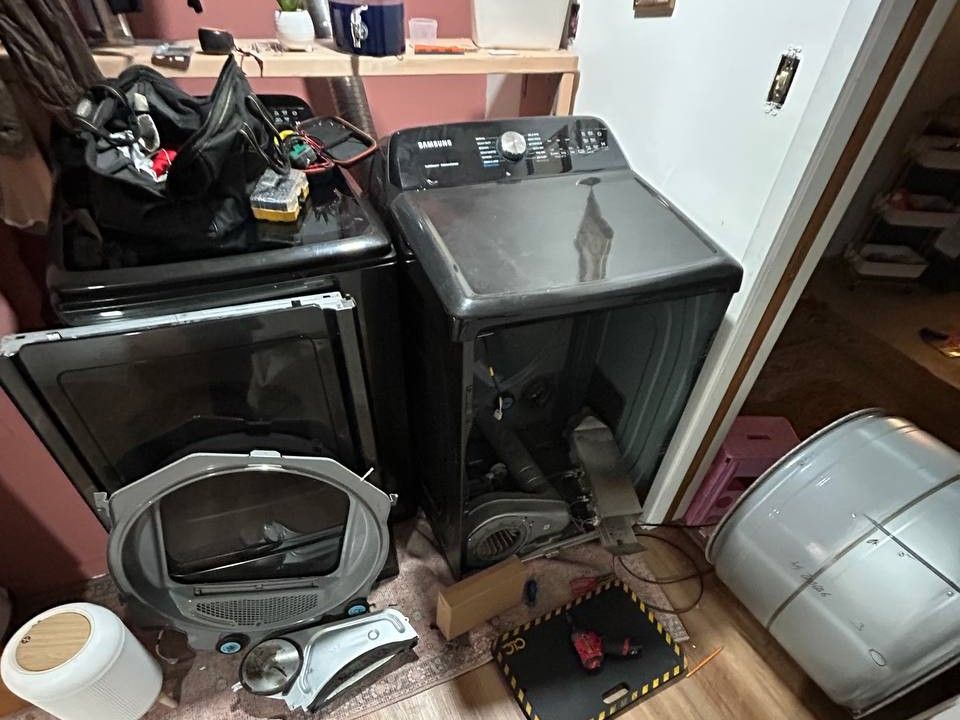
In a town that catches more rain than most of its neighbors, clotheslines are a summer novelty, and the dryer takes almost every load the rest of the year. In a student house a few blocks from the university, one machine may run from late afternoon well into the night on several days a week. That steady use shows up in predictable places: drum rollers and idler pulleys that start to squeal, belts that fray and snap, and thermal fuses that blow when lint has crept into the exhaust. None of those repairs is exotic, and most of the parts travel with your technician. A dryer that heats on one setting but not another is a slightly harder puzzle, usually a cycling thermostat or a relay on the control board, and we test those before condemning anything larger.
Electric dryers outnumber gas ones here. Bothell's homes split about 51 percent electric and 47 percent gas for heating, and the newer apartment and townhome blocks downtown and in North Creek are mostly electric in the laundry closet. Gas dryers turn up in houses that already have PSE gas for the furnace, more often in the older neighborhoods and the larger subdivisions. We repair both kinds from Whirlpool, Maytag, LG, Samsung, GE and Electrolux, including the dryer half of stacked laundry centers, and we always look past the dryer to the vent behind it.
What you seeDrum turns but the air stays cool
Likely causeOpen element or blown thermal fuse on electric; weak igniter on gas
What we doTest the heat circuit one part at a time and replace what failed
What you seeLoads take two cycles and the top feels hot
Likely causeRestricted exhaust: lint, a crushed duct or a clogged hood
What we doMeasure airflow at the outlet, clear the run and replace crushed duct
What you seeSqueal or rumble that grows louder every week
Likely causeDrum rollers, idler pulley or glides worn by constant use
What we doReplace worn rollers, pulley and belt together in one visit
What you seeMotor hums yet the drum sits still
Likely causeBroken belt or a seized idler pulley
What we doFit a new belt and pulley and check the motor's own bearings
What you seeShuts off a few minutes into every cycle
Likely causeOverheating trips the cycling thermostat or the motor overload
What we doFind the restriction or the weak motor, then replace the failed part
What you seeLint collecting under the home or along the skirting
Likely causeVent duct loose or crushed beneath a manufactured home
What we doReconnect with semi-rigid or rigid duct to a proper outside hood
Manufactured homes, about 6 in every 100 Bothell dwellings, have the trickiest dryer vents in town. The duct usually drops through the floor and runs beneath the home to an exit in the skirting. It must end outside that skirting, never inside the crawlspace, where lint and moisture would collect against the floor framing and the insulation. Settling, animals and storage can crush or disconnect that hidden run. When a dryer in one of these homes is slow or overheating, your technician checks the duct underneath where it can be reached safely, reconnects or replaces it with sturdier duct, and makes sure the hood flap swings open without sticking. A bird or rodent nest in that hood is a common find in the spring.
In the larger apartment buildings downtown, part of the 12 percent of local housing in complexes of 50-plus units, each dryer vents through a long run to the roof or an upper wall. We clear the transition duct and the first stretch we can reach, and measure airflow to show whether the rest of the run is restricted. Cleaning a roof termination or a building's shared duct chase belongs to the property manager's vent contractor, and our written findings give them what they need to schedule it.
Two quick habits help in any Bothell laundry room. Dryer sheets leave an invisible film on the lint screen that blocks air even after the lint is gone; wash the screen with warm soapy water now and then and hold it to the light to check. Moisture-sensing dryers also rely on two metal bars inside the drum, and a coating of softener residue makes them misread wet clothes as dry. A wipe with rubbing alcohol fixes it. On a gas dryer, one more rule overrides everything: smell gas, and the next move is out the door, with PSE or 911 phoned from the sidewalk.
Dryer repair in Bothell starts at $229, and the table climbs from a cleared vent or a new thermal fuse to electronic controls. Treat those as starting lines rather than a quote for your dryer. Once the $95 diagnostic is done, the precise figure goes on a written estimate, and nothing happens until you or your landlord say yes. Approve it and the diagnostic is credited; turn it down and the diagnostic is all you pay.
| Blocked vent cleared to the outside | from $229 |
|---|---|
| Thermal fuse or cycling thermostat | from $229 |
| Heating element (electric) | from $239 |
| Drum rollers, idler pulley, belt | from $239 |
| Igniter and gas valve coils | from $249 |
| Control board | from $259 |
| Diagnostic visit | $95, counted toward the repair |
| Another appliance on the same call | $10 off its diagnostic |
2026 starting prices for Lynnwood and nearby towns. The $95 diagnostic counts toward any repair you approve, and your technician writes the exact figure down before work begins.
Dryers are among the most repairable appliances in the house. Rollers, belts, pulleys, fuses, elements, igniters and thermostats are modest parts, and a dryer whose drum and cabinet are solid can run for many more years after they are replaced. We suggest replacement when the drum has rusted or cracked at the seam, when the motor and the control both fail at once, or when a board is no longer made for an older model. Stacked laundry centers raise a separate question: the washer and dryer are one appliance, so a major washer failure can doom a perfectly good dryer, and the reverse. In manufactured homes, check the vent location and closet width before buying, since a new dryer with its exhaust in a different spot may need the hidden duct rerouted. For rentals, the owner weighs our written estimate and makes the call.
Most moisture-sensing dryers judge dryness through two metal strips inside the drum, near the lint screen. Softener and dryer-sheet residue coats those strips and makes the dryer think the load is done. Wipe them with rubbing alcohol on a soft cloth. If the problem continues, the sensor wiring, the control or a vent restriction may be involved, and we can test each.
Outside the skirting, at a hood with a flap that opens when the dryer runs and closes when it stops. A duct that ends in the crawlspace leaves lint and moisture under the floor, which invites mold and creates a fire risk. If you see lint around the skirting or the dryer runs hot, have the duct under the home checked.
We clear the duct behind the dryer and as much of the run as we can reach from inside the unit, then measure airflow at the machine. Roof caps and the building's long duct runs are cleaned by the property manager's vent contractor. Our written findings show whether the restriction is beyond our reach, so the manager can schedule that work.
Leave the house right away without operating switches, outlets or the dryer, and phone PSE or 911 from a neighbor's yard or the street. PSE responds to gas odors throughout Bothell. After they have checked the line and declared it safe, book a visit if the dryer still has a fault, and tell us what happened so your technician can check the gas connections.
Yes. Laundry centers use the same heat, drum and start parts as standalone dryers, though the top section is reached through different panels. The owner or manager receives our written findings and price, we start once they approve, and leave the unit level and running. Tell us when booking who approves repairs and who will open the door.
Something not working?
To book, call (425) 287-5458 or use the online form; same-day Bothell visits are most likely when you reach us early. Your $95 diagnostic is applied to any dryer repair you approve, and a senior 65+, veteran or active-duty member of the household earns up to $18 off it.
Dryers
A dryer thermal fuse that blows again and again is a symptom. Crawl-space vents in older houses, stuck thermostats, grounded elements and slipping blowers.
Book a repair
Three quick steps. We call back to confirm a time; requests that come in during the morning can usually be seen the same day.
Rather call? (425) 287-5458 · Mon–Sat 8–7