Dryers
Dryer thermal fuse keeps blowing: find what is overheating it
A dryer thermal fuse that blows again and again is a symptom. Crawl-space vents in older houses, stuck thermostats, grounded elements and slipping blowers.
Dryers · gas and electric
No heat, two-cycle loads, a drum that squeals or won't turn: we repair gas and electric dryers in eleven towns around Lynnwood, test the vent and the supply along with the machine, and put the price in writing first.
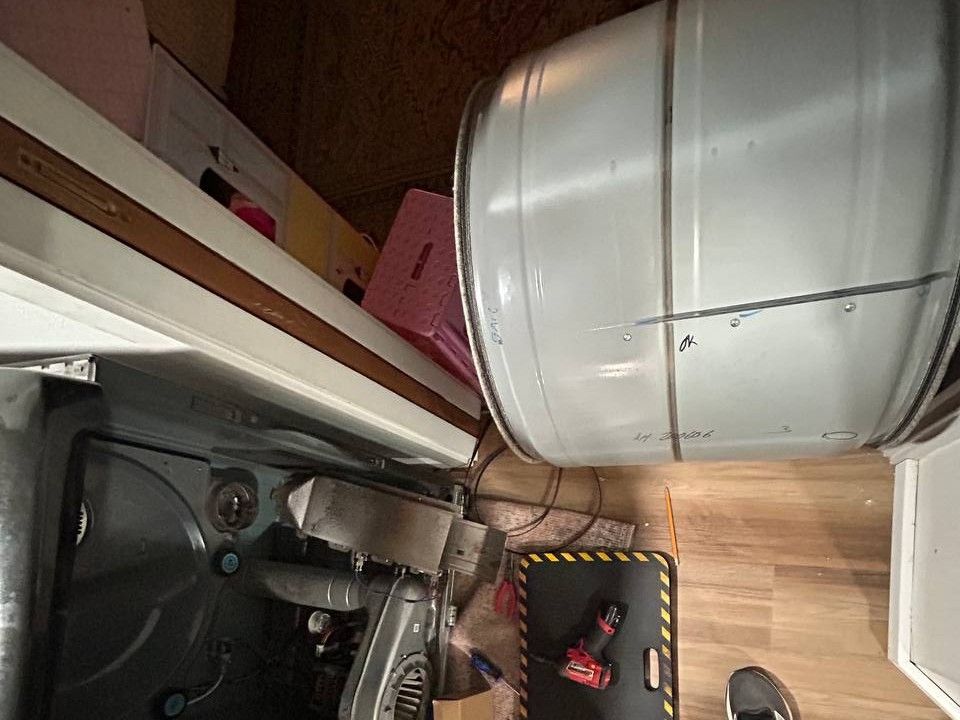
A large share of the dryers we see sit in apartments, condos and townhomes. About 21% of Lynnwood's homes are in buildings of 20 or more units, Everett's figure is 19% and Mountlake Terrace's 18%, and newer townhomes keep rising near the Lynnwood City Center, Mountlake Terrace and Shoreline light-rail stations. In those buildings the dryer often lives in a hall closet and exhausts through a long duct to a roof or an outside wall well away from the machine. Long runs collect lint, airflow drops, and the dryer starts cooking itself: blown thermal fuses, tired heating elements, and loads that need a second cycle. A new part on a choked vent fails again, which is why airflow gets checked on every dryer call, whatever the complaint. Townhomes add a twist of their own: laundry often sits on the top floor beside the bedrooms, and the vent climbs through the roof, where a stuck flap or a nest can block it without anyone noticing from inside.
Fuel varies from town to town. Home heating is a fair hint at whether a gas line reaches the laundry room: about 83% of Woodway homes heat with gas, 65% in Brier and 57% in Mill Creek, while Everett leans 68% electric and Lynnwood 63%. So we carry igniters, gas valve coils and flame sensors alongside heating elements, thermostats and fuses. Natural gas throughout our area comes from PSE. If you ever smell gas near a dryer, leave without touching any switch and call PSE or 911 from the yard or the street; we come back for the dryer once the utility has cleared it. Gas models turn up more in houses than in apartments, so a Brier or Mill Creek dryer call often starts at the igniter, while one in a south Everett apartment usually starts at an element or a fuse. The long wet season matters too, since heavier, wetter loads stretch every dryer's run time and expose a weak vent sooner.
What you seeRuns but blows cold air
Likely causeElectric: open element, thermal fuse or high-limit; gas: igniter, valve coils or flame sensor; or half of a double breaker tripped
What we doTest the supply first, then meter the heat circuit and replace the open part
What you seeLoads take two or three cycles
Likely causeRestricted vent, flattened transition hose, or lint packed in the screen housing
What we doMeasure exhaust airflow, clear the vent we can reach, straighten or replace the hose, and recheck the flow
What you seeDryer stops after a few minutes
Likely causeOverheating from poor airflow, a failing motor or a weak thermostat
What we doCheck temperatures and airflow, test the motor and both thermostats, and clear any lint the cabinet is holding
What you seeSqueal, rumble or thump
Likely causeWorn drum rollers, idler pulley, belt or drum bearing
What we doReplace the worn wheels, pulley or belt, check the drum seals and glides, and confirm a quiet run
What you seeNothing happens at start
Likely causeDoor switch, thermal fuse, start switch, motor or control board
What we doWalk the start circuit with a meter, part by part, and replace the failed link
What you seeBurning smell
Likely causeLint collected around the heater, or a motor overheating
What we doStop running it; we clean out the cabinet, test the heater and motor, and fix the cause
Your technician starts at the wall: the breaker and the voltage at a 240-volt outlet for an electric dryer, or the gas shutoff and the burner's behavior for a gas model. Then we run the dryer and watch. On an electric model we meter the element, the thermal fuse and the cycling and high-limit thermostats; on a gas model we watch the igniter glow and the flame catch, and test the valve coils and flame sensor. Airflow gets measured at the exhaust, because a vent problem disguises itself as a heating problem more often than any other fault. Belts, rollers, idlers, fuses, thermostats, elements, igniters and coils are carried in the vehicle, so most dryer repairs are done on the first visit. If clothes come out smelling scorched or the drum is too hot to touch, we test the cycling thermostat with the heater running, because a stuck thermostat can overheat a dryer even on a clean vent. Before we leave, the dryer runs a timed load with its panels back on, and we check the exhaust temperature at the hood.
The brands we see most are Whirlpool, Maytag, LG, Samsung, GE, Electrolux, Frigidaire, Bosch, Speed Queen and Kenmore-label models, in standard, stacked and laundry-center form. Outside our scope: the home's wiring beyond the dryer's cord and terminal block, and commercial or coin-op dryers. A melted outlet or a breaker that trips on a healthy dryer is a job for an electrician, and we tell you so with the readings in hand. Long building vents in condos can also run beyond what we can reach from inside your unit. We clean the section we can, measure what the dryer is getting, and say so when the rest is a matter for the building. Any gas smell goes to PSE first; the dryer's own burner parts are ours.
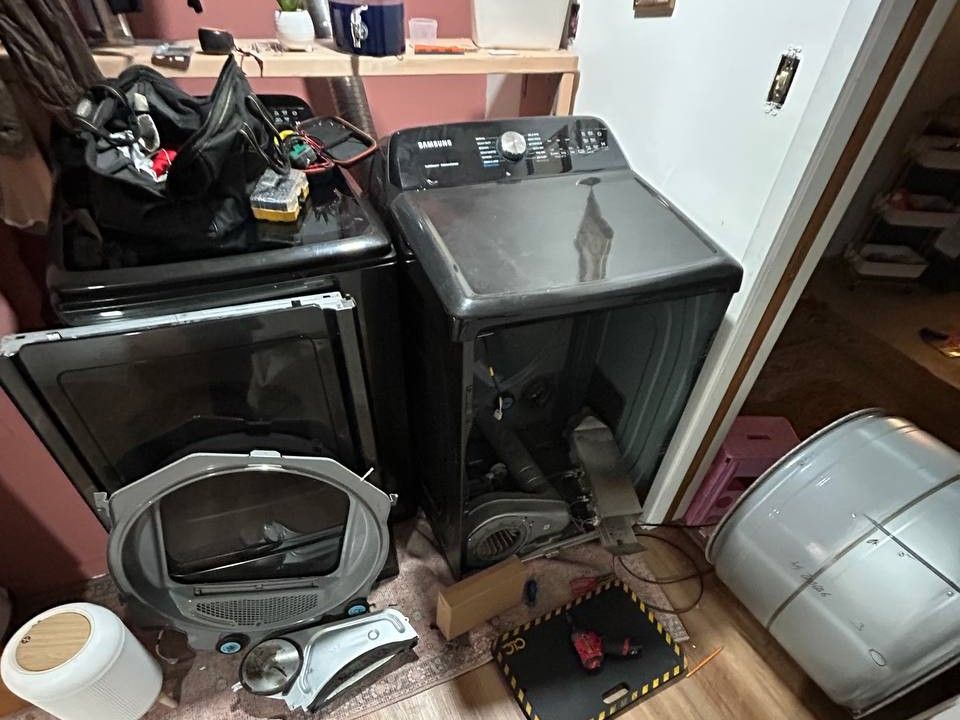
Dryer repairs start from $229, the lowest of our appliance categories, and the table below shows the common jobs. Starting prices are a guide, not a quote: your price is on the written estimate after the $95 diagnostic, and nothing is done without your approval. Approve it and the diagnostic goes toward that repair; if the washer also needs a look while we're there, its diagnostic comes $10 off. Seniors 65+, veterans and active-duty military households can take up to $18 off the dryer repair.
| Blocked vent cleared to the outside | from $229 |
|---|---|
| Thermal fuse or cycling thermostat | from $229 |
| Heating element (electric) | from $239 |
| Drum rollers, idler pulley, belt | from $239 |
| Igniter and gas valve coils | from $249 |
| Control board | from $259 |
| Diagnostic visit | $95, counted toward the repair |
| Another appliance on the same call | $10 off its diagnostic |
2026 starting prices for Lynnwood and nearby towns. The $95 diagnostic counts toward any repair you approve, and your technician writes the exact figure down before work begins.
Dryers
A dryer thermal fuse that blows again and again is a symptom. Crawl-space vents in older houses, stuck thermostats, grounded elements and slipping blowers.
It depends on the run. A short vent straight through an outside wall can go a long time between cleanings, while a long apartment duct may clog within months. Watch for warning signs rather than the calendar: loads taking longer, a hot laundry room, a cabinet that feels very hot on top, or lint gathering around the door. Any of those means the vent needs attention.
The table lists electric elements and gas igniters as separate jobs, and they start at different points, but the $95 diagnostic is the same either way. Gas models add a few parts to check, including valve coils and a flame sensor, while electric models add a heating element and a 240-volt supply. Your written estimate names exactly which part failed and what replacing it costs.
Sometimes. A shorted element, a damaged terminal block or a failing motor can trip a healthy breaker. So can a worn breaker or a scorched outlet. We test both sides, and if the fault is in the house wiring or the panel, we tell you it belongs to an electrician before anything is replaced. Don't keep resetting a breaker that trips again and again.
Yes. Closet dryers in apartments and condos make up a large part of our dryer work, especially in Lynnwood, Everett and Mountlake Terrace. We ease the dryer out carefully, check the transition hose behind it, which tight closets tend to crush, and clean the part of the vent we can reach. Tell us about stairs or narrow access when you book.
For a short while, with care, but don't ignore it. Slow drying usually means restricted airflow, and restricted airflow means heat building up around the heater and lint. Clean the lint screen before every load, check that the hose behind the dryer isn't flattened, and never leave a slow dryer running when nobody is home. Book a visit if the next few loads don't improve.
Something not working?
Dryer not heating? Dial (425) 287-5458 or use the online booking form; a morning call gives you the clearest chance of a same-day visit. The $95 diagnostic is credited when you approve the repair, and seniors 65+, veterans and active-duty military households get up to $18 off.
Book a repair
Three quick steps. We call back to confirm a time; requests that come in during the morning can usually be seen the same day.
Rather call? (425) 287-5458 · Mon–Sat 8–7