Washers
Stacked washer full of water: sorting it out in an apartment closet
Water left in a stacked washer in a Lynnwood, Mountlake Terrace or Everett apartment: suds in soft water, pump filters, folded hoses and the building drain.
Washers · Mill Creek and Silver Firs
Most Mill Creek washers sit upstairs or in a closet, where a slow leak travels before anyone sees it. We repair front- and top-loaders all over town and explain why the very soft water here calls for less detergent.
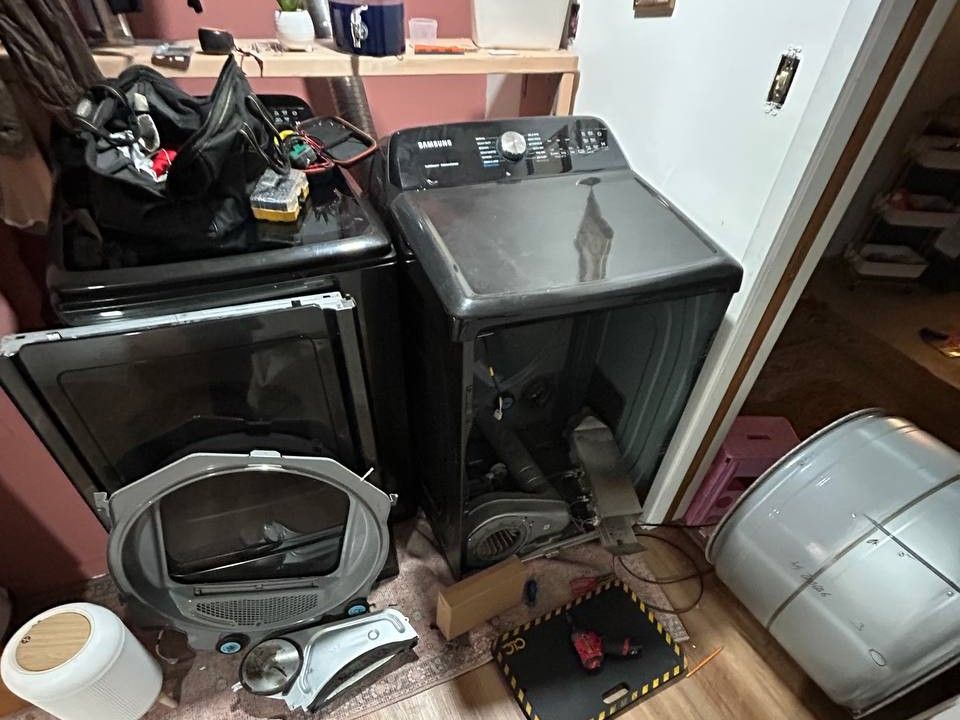
Many two-story houses in Mill Creek East and the later city subdivisions put the laundry room on the bedroom floor, a few steps from the closets where clean clothes end up. It saves trips on the stairs. It also means a torn door boot or a split fill hose drips onto drywall instead of a concrete slab. Many of those rooms have no floor drain, and some have a plastic pan that was never piped to anything, so the first sign of trouble is often a tan ring on the ceiling below, weeks after the leak began. That is why we treat any water under a second-floor washer as urgent, even while the machine still finishes its loads.
The other Mill Creek pattern starts at the tap. Water from the Spada Reservoir reaches every address in town at about 12.5 parts per million of hardness, among the softest supplies in the region, and detergent foams far more in it than the bottle assumes. High-efficiency washers use very little water, so surplus suds cushion the drum, confuse the pressure sensor and stretch a cycle by half an hour or halt it with an error. Before we replace a pump or a board, we rule that out. Whirlpool, Maytag, LG, Samsung, Electrolux, GE and Speed Queen machines are all part of the work, front- and top-load, along with the stacked laundry centers in the newer buildings.
What you seeLong cycles, a suds code, or foam pressed against the door glass
Likely causeToo much detergent for very soft water, sometimes a weak drain pump
What we doRinse out the foam, test the pump and pressure system, and set a lighter dose
What you seeBrown stain spreading across the ceiling below the laundry
Likely causeDoor boot tear, loose fill hose or a cracked pump housing
What we doOpen the panels, trace the drip to its source and replace the leaking part
What you seeWater left in the drum and the spin never starts
Likely causeDrain pump clogged with a sock, coin or hair tie, or the pump has failed
What we doClear the pump trap and hose, then fit a new pump if it is weak
What you seeFront-load door stays locked after the cycle ends
Likely causeDoor lock assembly or its latch striker worn
What we doRelease the door safely, test the lock circuit and install a new lock
What you seeTop-loader hums but will not agitate or spin
Likely causeDrive belt slipping, coupler broken or a shifter fault
What we doInspect the drive, replace the belt or coupler and test both modes
What you seeWasher shuffles across the floor on spin
Likely causeWorn shocks or suspension rods, or uneven feet on a framed floor
What we doReplace the worn suspension parts as a set and level the machine
An upstairs washer stands on a wood-framed floor that flexes a little with every spin, and that motion wears shocks and suspension rods faster than a slab ever would. On these visits your technician checks more than the failed part: the fill hoses, which should be braided steel rather than rubber; the drain pan and whether it actually drains; and the shutoff valves behind the machine, which should turn easily by hand. A stuck valve is worth knowing about before the day a hose bursts. If the floor itself has gone soft from an old leak, we point it out so a carpenter can look before the machine goes back in place.
The rental and condo buildings around Town Center, East Gateway and The Farm lean on stacked washer-dryer pairs tucked behind bifold doors. Getting to a pump or door lock means sliding the whole stack out of a closet built for it with little to spare, which is routine for us and awkward for anyone else. Some associations require a drain pan under every unit, and shared walls make an out-of-balance spin a neighbor issue as well as a repair. If you rent, tell us whether the owner or the property manager approves repairs, so the written estimate goes to the right person.
Back to that soft water. Leftover detergent does not rinse away cleanly, so it collects in the dispenser drawer and in the folds of the door boot, where it turns into gray slime and a musty smell. Measure to the lowest line, use HE detergent only, wipe the boot after the last load of the week and leave the door ajar. In the older plat houses near the fairways, where laundry often sits off the garage, we still find sturdy top-loaders that only need a belt or a lid switch.
Washer jobs here begin at $239, and the table lists the common repairs from the lowest starting point up. That number is the floor of the category, not a price for your machine; once the $95 diagnostic shows what actually failed, your technician writes the exact figure on an estimate and waits for your approval. Agree to the repair and the diagnostic counts toward it. A leak or suds fault that turns out to need only a hose, a cleanout or a detergent change is noted as such, so you are not sold a part the washer does not need.
| Fill (inlet) valve | from $239 |
|---|---|
| Lid switch or door lock | from $239 |
| Drive belt or motor coupler | from $245 |
| Drain pump | from $249 |
| Shocks, springs or suspension rods | from $255 |
| Control or motor board | from $265 |
| Diagnostic visit | $95, counted toward the repair |
| Another appliance on the same call | $10 off its diagnostic |
2026 starting prices for Lynnwood and nearby towns. The $95 diagnostic counts toward any repair you approve, and your technician writes the exact figure down before work begins.
Most washer failures we find here are wear items: pumps, door locks, boots, belts, valves and suspension parts. On a machine that is otherwise sound, those repairs are usually worth doing, and in an upstairs laundry room a repair has one more advantage, because nobody has to carry a heavy front-loader down the stairs and a new one back up. The math changes with a roaring spin from worn tub bearings, a cracked outer tub, or a control board on a machine that is already near the end of its expected life. Those faults usually point to replacement, and we say so in the estimate rather than selling a repair that will not last. Stacked units in the newer buildings add a size question: any replacement must fit the closet, the doors and the hookups, which narrows the choices and makes fixing the current pair more attractive.
Less than the package suggests. Mill Creek's water is very soft, about 12.5 ppm of hardness, so detergent foams heavily. For a normal load in an HE machine, fill only to the first line of the cap or use one small pod, and skip extra softener. If you see foam in the door glass or cycles running long, cut the dose further and run an empty rinse to clear the residue.
Stop using the washer and close the two water valves behind it. Wipe up anything on the laundry floor and check whether the pan under the machine holds water. Then call us; your technician will pull the panels, run a short fill and find whether the drip comes from a hose, the door boot, the pump or the tub. Have the drywall dried out before it is patched.
Yes. Stacked laundry centers and separate stacked pairs are common in the Town Center and East Gateway buildings, and we work on both. We slide the unit out, protect the flooring, make the repair and reset the stack so it sits level. If the closet is very tight, mention it when booking so your technician arrives with the right dollies and pads.
Usually detergent and lint residue trapped in the door boot, dispenser drawer or drain pump filter, made worse by a closed door between loads. Clean those three spots, run a hot cleaning cycle and leave the door open afterward. If the smell returns quickly or water sits in the drum, a slow drain or a partly blocked pump may be the real cause, and that is a repair we handle.
No. Silver Firs, Mill Creek East and Martha Lake are part of our regular area and priced exactly like an address in central Lynnwood. The diagnostic fee is the same everywhere we go, and it counts toward the repair if you go ahead. The drive from Lynnwood is roughly a quarter hour, a little more for the far east side.
Something not working?
Phone (425) 287-5458 Monday through Saturday, or book your washer visit online in three steps. If you approve the repair, the $95 diagnostic is credited toward it, and seniors 65+, veterans and active-duty military families save up to $18 on the work itself.
Washers
Water left in a stacked washer in a Lynnwood, Mountlake Terrace or Everett apartment: suds in soft water, pump filters, folded hoses and the building drain.
Book a repair
Three quick steps. We call back to confirm a time; requests that come in during the morning can usually be seen the same day.
Rather call? (425) 287-5458 · Mon–Sat 8–7