Washers
Stacked washer full of water: sorting it out in an apartment closet
Water left in a stacked washer in a Lynnwood, Mountlake Terrace or Everett apartment: suds in soft water, pump filters, folded hoses and the building drain.
Washers · Mountlake Terrace
Mountlake Terrace laundry splits two ways: a top-loader in the garage of a post-war house, or a compact stacked unit in a Town Center apartment. We repair both, a few freeway exits south of central Lynnwood.
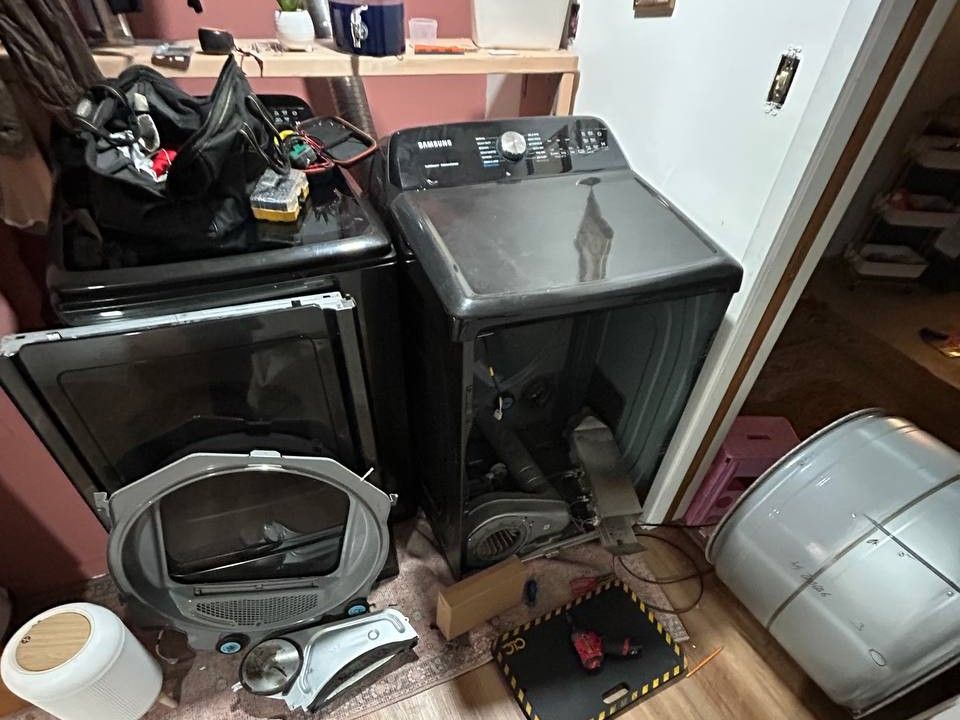
Most of the first houses in Mountlake Terrace were built without a proper laundry room. Washers were later set wherever the plumbing could reach, often beside the water heater, against a garage wall or in an enclosed back entry, and many are still there. Those spots are cold in winter and damp for much of the year, and they often drain into a standpipe or utility sink that was added long after the house was built. A washer that empties into a short or partly blocked standpipe, or sits on a sloping garage slab, shows its complaints as overflow, walking and loud spins rather than as a clean error code.
Town Center is a different laundry room altogether. The mid-rises built since 2013, and the apartments still opening near I-5, mostly use stacked laundry centers or compact front-loaders in closets. Those machines are electronic, efficient and tightly packed, and their failures are door locks, drain pumps, water-level sensing and control boards. A drip there is also a problem for the unit downstairs, which is why we treat any leak in a multi-story building as the first thing to find. Renters in those buildings should also know who approves repairs before we arrive, since the written estimate goes to whoever signs off.
What you seeWater on the garage floor during the drain
Likely causeStandpipe too short or partly blocked, so the drain backs up and spills
What we doCheck the hose height and flow, clear the hose and pump, explain what the standpipe needs
What you seeTop-loader spins slowly and leaves clothes soaked
Likely causeWorn clutch or drive coupler, or a lid lock that will not engage
What we doTest the lid lock, inspect the drive and replace the worn component
What you seeWasher thumps and walks across the slab
Likely causeUnlevel feet, worn suspension rods or an overloaded drum
What we doLevel the machine, replace suspension parts and talk through load size
What you seeStacked front-loader will not start, lock clicks
Likely causeDoor lock failing, or the latch catching on the door boot
What we doReplace the lock, check the latch alignment and the boot lip
What you seeSlow-fill error on a cold morning
Likely causeInlet valve screens clogged, or a supply valve only partly open
What we doClean or replace the valve screens, check the hoses and the valve itself
What you seeMildew on the door gasket despite cleaning
Likely causeWater trapped in the boot fold while damp air slows drying
What we doSwap a torn boot, flush the drain route and set up a drying habit
Nearly half the homes here predate 1970, and in the older houses the washer tends to sit wherever there was room. In a garage, the floor slopes toward the door, so a washer that was never leveled rocks on two feet and pounds through every spin, wearing out suspension rods and snubbers. The supply hoses run along cold walls and are often the original rubber kind, which is worth replacing with braided hoses before one bursts. And the drain usually goes into a standpipe or laundry sink that nobody has looked at since it was installed; a slow standpipe is the most common cause of water on a Mountlake Terrace garage floor.
A building near the light-rail station may hold dozens of nearly identical stacked units. When several of them show the same fault, such as slow drains or fill errors on upper floors, the building's drain stack or water pressure deserves a look as well as the machine. We note those patterns in the written estimate so the owner or manager can follow up. Closet installs also make filter access awkward, so many tenants have never opened the drain pump filter on their front-loader; we show you where it is and how to clear it safely.
The city sits in the Puget Sound convergence zone, and the extra showers keep garages and porches damp well into spring. For front-loaders that means door boots and detergent drawers that never dry fully, which is where the musty smell begins. Very soft city water, bought from the Alderwood district with well under a grain of hardness per gallon, makes detergent foam easily, so the cure is usually less soap, warmer cycles now and then, and the door left open between loads. A small fan or a dehumidifier in a closed-in porch laundry helps more than most people expect.
Washer work in Mountlake Terrace begins at $239, covering belts, inlet valves, door locks, pumps, suspension parts and boards. That figure starts the scale; it is not your quote. Your technician completes the $95 diagnostic, writes the exact price into an estimate and waits for your answer before any part is replaced. If the fix turns out to be a hose, a level or a dosing change, we tell you that before suggesting anything bigger.
| Fill (inlet) valve | from $239 |
|---|---|
| Lid switch or door lock | from $239 |
| Drive belt or motor coupler | from $245 |
| Drain pump | from $249 |
| Shocks, springs or suspension rods | from $255 |
| Control or motor board | from $265 |
| Diagnostic visit | $95, counted toward the repair |
| Another appliance on the same call | $10 off its diagnostic |
2026 starting prices for Lynnwood and nearby towns. The $95 diagnostic counts toward any repair you approve, and your technician writes the exact figure down before work begins.
Top-loaders in post-war garages are often older direct-drive or belt-drive machines with simple controls, and most of their failures are inexpensive: couplers, lid switches, pumps and suspension rods. Keeping one running is usually the better value, especially when a newer machine would need a level floor and a better drain to work well. Stacked units in Town Center apartments are a different calculation, because the two machines are built as one cabinet, and losing either half usually means buying the pair; a lock, pump or valve is still a clear repair, but a major board on an older stack may tip the decision. Front-loaders that roar during spin usually have worn tub bearings, which on many designs means replacing the outer tub, and that is rarely worth it. We put the options in writing so you can compare them with a clear head.
Yes, with a few precautions. Level the machine carefully on the sloping slab, replace old rubber supply hoses with braided ones, and make sure the standpipe drains without backing up. In a hard freeze, water left in the valve or pump can do damage, so keep the garage door closed. If the washer sits beside the water heater, keep the area around both clear.
Leaks that appear only in spin usually come from the drain side: a loose hose clamp at the pump, a cracked pump housing, or a drain hose that is not secured in the standpipe and sprays water as the pump pushes. A torn door boot can also leak when the drum moves. Put a towel down, stop using the machine and book a visit so we can find the exact source.
That is by design. Most top-loaders lock or stop the spin when the lid opens to keep hands away from a moving basket. If the washer will not run at all with the lid closed, or the lock never releases at the end of a cycle, the lid switch or lock assembly may have failed. Those are common, moderate repairs that we usually finish in one visit.
Most front-loaders have a small door at the bottom front. Lay towels and a shallow pan in front of it, open the door, pull out the short drain hose if there is one and let the water out, then unscrew the filter slowly. Remove lint, coins and hair ties, then refit it snugly. If the filter will not turn or water keeps flowing, stop and call us.
Yes. Adding the dryer to the same visit takes $10 off its diagnostic, and each machine gets its own written estimate, so you can approve one repair and not the other. Tell us about both when you book, so likely parts for each come along and we leave enough time to slide a stacked unit out and back.
Something not working?
Phone (425) 287-5458 or book online, noting whether the washer stands in a garage or an apartment closet. If you say yes to the repair, the $95 diagnostic goes into its price, and up to $18 comes off for customers who are 65 or older, veterans, or members of an active-duty military household.
Washers
Water left in a stacked washer in a Lynnwood, Mountlake Terrace or Everett apartment: suds in soft water, pump filters, folded hoses and the building drain.
Book a repair
Three quick steps. We call back to confirm a time; requests that come in during the morning can usually be seen the same day.
Rather call? (425) 287-5458 · Mon–Sat 8–7