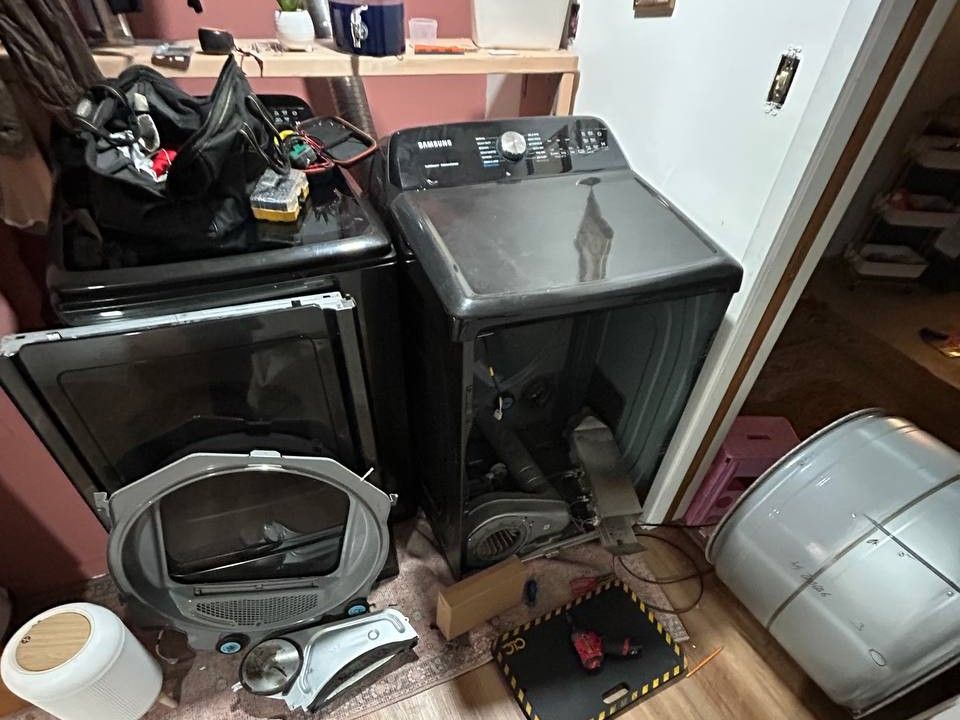
Only about 45% of Lynnwood's homes are detached houses. Roughly one unit in five sits in a building with twenty or more apartments, and in North Lynnwood it is closer to one in three. Add the mid-rises around Mountlake Terrace's Town Center, the buildings going up within walking distance of the light-rail stations that opened in August 2024, and Everett's mix of apartments and older multiplexes, and a large share of the washers we open are stacked in a closet off a hallway.
That setup brings its own drain trouble. The machine is pushed tight to the wall, the pump sits at the bottom of a tall stack, and the drain empties into plumbing shared with the neighbors. When a cycle ends with water still in the drum, here is how to narrow it down before anyone takes a panel off.
A few safe checks first
- Read the display. A drain code, such as OE on many LG front-loaders or 5C or 5E on Samsung models, means the control waited for the water level to fall and it never did. A suds code points somewhere else, covered below.
- Look at the drain hose behind the stack with a flashlight. In a shallow closet the hose often folds flat when the machine is shoved back after cleaning or a move.
- Watch the standpipe or laundry box while the washer tries to drain. If water rises out of it, or a sink nearby gurgles, the blockage is in the building's drain line and not in the washer.
- Clean the drain pump filter on a front-loader that has one, usually behind a small door at the lower front. Unplug the washer first, lay down towels and a shallow pan, and open the cap slowly; a full drum lets out more water than most people expect. Coins, hair ties, bra underwires and baby socks are the usual finds.
Soft water and suds lock
Lynnwood, Mountlake Terrace and Everett all draw from Spada Reservoir, and that water averages about 12.5 parts per million of hardness, well under a grain per gallon. Detergent foams far more in water this soft. A front-loader that senses heavy suds will hold off draining or add rinses to keep foam from pouring out past the door boot, sometimes flashing a code such as SUD. From the hallway it looks exactly like a washer that refuses to drain.
Use HE detergent only, measure to the first line on the cap or below it, and resist adding a second scoop for bulky loads. If the drum is full of foam right now, a rinse-and-spin cycle with no detergent at all usually clears it.
Two kinds of stack
A laundry center is one cabinet: a top-loading washer in the base with a dryer built above it, made by GE, Frigidaire, Whirlpool and Maytag among others. The pump, lid switch and drain hose sit low in that cabinet, and reaching them usually means bringing the whole unit out of the closet.
A stacked pair is two front-load machines joined by a stacking kit, common with LG, Samsung, Whirlpool and Electrolux, and with compact 24-inch European units from Bosch and Miele. The drain pump lives in the bottom machine and is usually reached from the front. Single-column designs such as LG's WashTower are built as one piece with the controls in the middle. In every case the dryer overhead makes the job slower without changing the diagnosis.
What usually fails
- Drain pump. You hear a hum or buzz at drain time and nothing moves, or the pump runs and the water stays. Something caught in the impeller can stall it, and a pump that ran stalled for weeks often wears out.
- Lid switch or door lock. If the control cannot confirm the door is locked, many washers will neither drain nor spin. It looks like a drain fault and is not.
- A clog inside the cabinet, typically at the bend where the hose leaves the tub or at the pump inlet.
- Pressure sensor or its small air hose. When the control misreads the water level, it can stop with water inside or refuse to advance.
- Control board, less often. We test the pump circuit before anyone talks about a board.
Leaks and the unit below
In a building, a washer that will not drain is also a leak risk for whoever lives downstairs. Do not keep restarting the cycle hoping it clears. Switch the washer off, close the water shutoff valves behind it if you can reach them, and keep a front-loader's door shut until towels and a pan are ready. If water has already reached the floor, let the building manager know so the ceiling below can be checked.
Renting or owning
If you rent, the stacked unit usually belongs to the property owner, and the lease decides who arranges repairs. Condo owners, and many townhome owners near Lynnwood City Center and the Shoreline stations, own their machines and can book us directly. Drain lines inside the walls belong to the building; when the clog is past the standpipe, we say so, and the association's plumber takes it from there.
Booking
Call (425) 287-5458 or book online, and read us the model number from the label inside the door or under the lid. Common washer parts ride in the vehicle, so many stacked-washer drain repairs wrap up on the first visit. The $95 diagnostic goes toward the repair once you approve the written estimate. Washer repairs start at $239, which is where the category begins rather than a quote for your machine; the estimate gives the exact figure before work begins. Seniors 65+, veterans and active-duty military households can take up to $18 off the repair. There is more on our washer repair page.