Washers
Stacked washer full of water: sorting it out in an apartment closet
Water left in a stacked washer in a Lynnwood, Mountlake Terrace or Everett apartment: suds in soft water, pump filters, folded hoses and the building drain.
Lake Forest Park · Washers
Lake Forest Park washers tend to live in basements, garages and back rooms of older houses. We repair front-load, top-load and stacked machines there, and check the hoses, valves and drains they depend on.
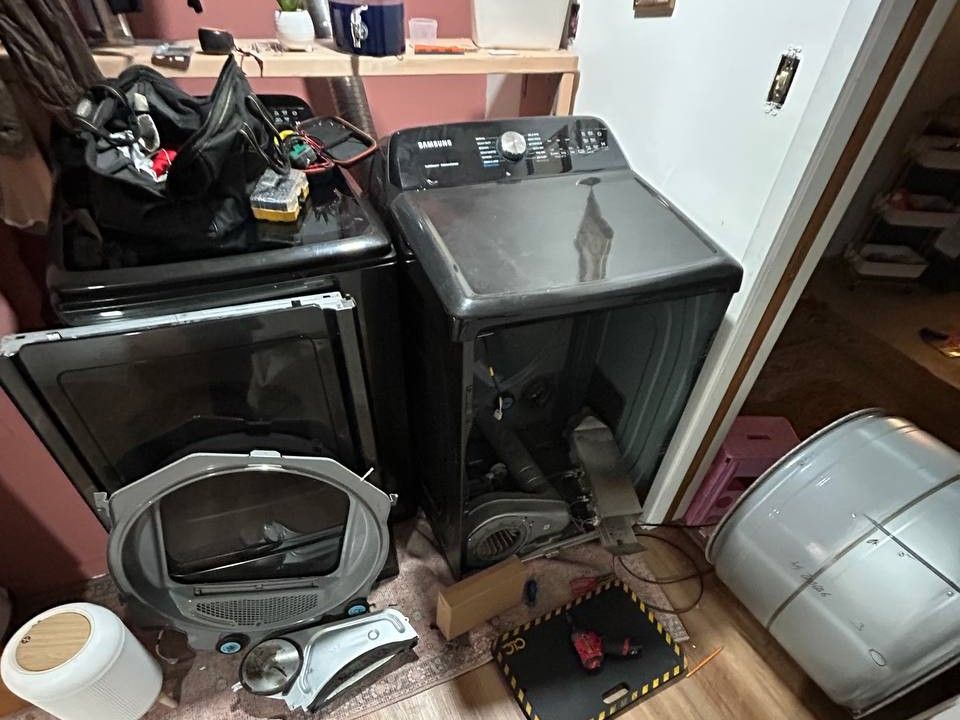
Few of Lake Forest Park's houses were built with the laundry room people expect today. In homes from the 1920s through the 1970s, the washer went wherever the plumbing allowed: beside the water heater in the basement, at the back of an attached garage, or in a room off the kitchen that a later remodel carved out. Those spots work, but they come with quirks that show up in our diagnoses. Supply valves that have not been turned in years seize or drip when someone finally closes them. Rubber fill hoses age out unseen behind the machine. Wood floors in older framing flex, so an unbalanced spin rattles the whole room.
We repair the machines themselves: front-loaders with failing door locks or pumps, top-loaders with worn suspension or broken lid switches, and stacked laundry centers squeezed into tight closets. During the diagnosis we also test the outlet and look at the hoses, valves and drain the washer relies on, because a perfectly good washer hooked to a cracked hose or a slow drain keeps getting blamed for problems it did not cause. Your technician puts the price on paper before any work begins.
What you seeBulge or crack in a rubber fill hose
Likely causeHose at the end of its life
What we doReplace both hoses with reinforced ones and check the washers in the fittings
What you seeDrips from the wall valves after someone turned them
Likely causeOld stem packing or a valve seized in place
What we doCheck our connection; valve replacement in the wall is plumbing, and we say so
What you seeFront-loader smells musty, worse in winter
Likely causeDamp lower-level room, door closed between loads, residue in the boot and pump trap
What we doClean the pump filter and boot, replace a mildewed boot, set up a drying routine
What you seeSpin shakes the floor and the machine creeps
Likely causeWorn shocks or springs, or uneven feet on an old wood floor
What we doReplace suspension parts, level the feet and check the floor beneath
What you seeStops with water in the drum and a drain code
Likely causeClogged pump filter, a failed pump or a kinked drain hose
What we doClear the filter and hose, test the pump and replace it if needed
What you seeTop-loader fills but won't agitate or spin
Likely causeLid switch, shifter or drive coupling failure
What we doTest the lid switch and drive parts and replace the one that broke
Damp is part of life in this town. It sits in the Puget Sound Convergence Zone, many lots are shaded by tall trees, and the Lyon Creek and McAleer Creek ravines hold cool, moist air through much of the year. A front-load washer in a lower-level laundry room here rarely dries out on its own. Leave the door and dispenser drawer open after each load, run a hot cleaning cycle once a month, and wipe the bottom fold of the door boot. When a boot has gone black inside its folds, replacing it is the only lasting fix, and that is a repair we make regularly.
Your water source changes how much detergent a washer can take. Three of the town's four water providers, North City Water District, Seattle Public Utilities and Northshore Utility District, deliver soft Tolt River water at about 1.2 to 1.4 grains per gallon, where full doses of detergent foam over easily. The fourth, the Lake Forest Park Water District, supplies groundwater to about 3,171 people, and its hardness is not published in any source we could check. If your bill comes from the district, tell us when you book; we will look at the dispenser, the inlet screens and the heater for signs of scale before assuming soft-water habits apply.
Older houses also mean older hoses and valves. A rubber fill hose that has been behind the washer since an early remodel is a real flood risk over a finished basement or a wood floor, and swapping it for a reinforced one takes only minutes during a visit. If a wall valve weeps or will not close, that part belongs to the house plumbing; we will show you the drip and suggest a plumber. The safe check before calling: if water is spraying, close both supply valves behind the machine, unplug it and leave the drain hose where it is.
Washer repairs begin at $239; the table alongside shows where belts, valves, locks, pumps, suspension parts and boards land. A starting price is not a quote. Your technician gives you a written estimate with the actual figure after diagnosing the machine, and the $95 diagnostic is credited to the repair when you approve it.
| Fill (inlet) valve | from $239 |
|---|---|
| Lid switch or door lock | from $239 |
| Drive belt or motor coupler | from $245 |
| Drain pump | from $249 |
| Shocks, springs or suspension rods | from $255 |
| Control or motor board | from $265 |
| Diagnostic visit | $95, counted toward the repair |
| Another appliance on the same call | $10 off its diagnostic |
2026 starting prices for Lynnwood and nearby towns. The $95 diagnostic counts toward any repair you approve, and your technician writes the exact figure down before work begins.
In an older Lake Forest Park house the room often decides as much as the machine does. A washer that fits a narrow basement stair, a tight garage alcove or a closet with an odd door width is worth keeping, and most of its common failures, from pumps and lid switches to door locks and suspension, cost far less than a new machine plus the work of getting it into place. We suggest replacing when a front-loader's tub bearing has failed, when the outer tub is cracked, or when years in a damp basement have rusted the cabinet and frame. Older top-loaders with simple mechanical controls are often the easiest to keep going, as long as their drive parts are still made. We will give you the repair price in writing and tell you whether we would fix it if it were ours.
Check them every year: look for bulges, cracks, stiffness or rust at the fittings. Plain rubber hoses are worth replacing every few years even when they look fine, and reinforced hoses last longer. If your hoses date from before you moved in, it is a good time to change them. We can swap them during any washer visit.
The odor usually lives where a cleaning cycle doesn't reach: the pump filter trap behind the small door at the bottom front, and the deep folds of the door boot. Lint, hair and detergent residue collect there and stay wet. Clean both, leave the door open between loads, and cut the detergent dose. If the boot itself has turned black, it needs replacing.
It can. Water left in the inlet valve, pump or hoses can freeze in a cold snap and crack them, which shows up as a leak the next time you run a load. If your garage gets close to freezing, close the supply valves, disconnect and drain the hoses, and run a short drain cycle so the pump is empty.
For the washer, mostly when it comes to detergent. On soft Tolt water from North City, Northshore or Seattle Public Utilities, a smaller dose works and avoids foam faults. On Lake Forest Park Water District groundwater, whose hardness isn't published, we check for scale on the inlet screens and heater before suggesting a change.
Only the $95 diagnostic. Your technician explains what failed and gives you a written estimate; if you say no, that diagnostic is the whole bill and there is no distance charge for coming to Lake Forest Park. If you say yes, the diagnostic is credited toward the repair.
Something not working?
Book online or call (425) 287-5458 for washer repair in Lake Forest Park. The $95 diagnostic is credited toward the repair if you go ahead, and households with a senior 65+, a veteran or an active-duty service member get up to $18 off the repair.
Washers
Water left in a stacked washer in a Lynnwood, Mountlake Terrace or Everett apartment: suds in soft water, pump filters, folded hoses and the building drain.
Book a repair
Three quick steps. We call back to confirm a time; requests that come in during the morning can usually be seen the same day.
Rather call? (425) 287-5458 · Mon–Sat 8–7