Washers
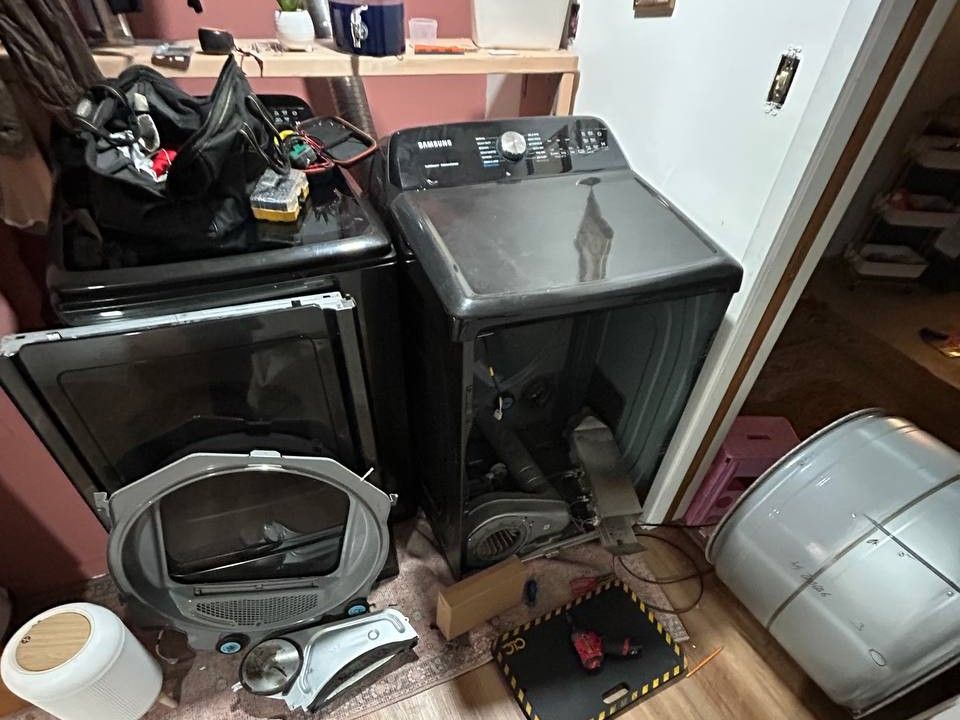
Stacked washer full of water: sorting it out in an apartment closet
Water left in a stacked washer in a Lynnwood, Mountlake Terrace or Everett apartment: suds in soft water, pump filters, folded hoses and the building drain.
Shoreline · Washers
Shoreline's tap water is soft enough that a normal scoop of detergent can stall a front-loader. We separate chemistry from failed parts, then repair front-load, top-load and stacked washers across the city.
Seattle's February 2026 water sampling measured Tolt River supply at about 1.2 grains of hardness per gallon leaving the plant and about 1.4 in the distribution pipes. That is the water running into every Shoreline washer, whether the house sits west of I-5 on Seattle Public Utilities or east of it on North City Water District. Water that soft rinses easily and leaves almost no scale on valves or heaters. It also lets detergent foam far more than the cap line assumes, and a front-loader that senses too much foam will pause, add rinses, struggle to drain and sometimes throw a code that looks exactly like a failed pump.
So part of every Shoreline washer visit is sorting a dosing problem from a mechanical one. Sometimes the pump really has failed, a coin has cracked its impeller, or the door lock has stopped reporting closed. Sometimes the machine is healthy and simply drowning in suds. We repair front-load and top-load machines and stacked laundry centers, test the outlet and the water supply as part of the diagnosis, and write the estimate before any part leaves the vehicle.
What you seeDrum still sudsy at the end and the cycle runs long
Likely causeToo much detergent for soft water, sometimes with a weak drain pump
What we doClean the pump filter, test the pump and set a dose that suits the water
What you seeMusty smell and dark spots in the folds of the door seal
Likely causeWater held in the boot and residue in a damp laundry room
What we doClean or replace the boot and make sure the drain path is clear
What you seeTop-loader bangs against the cabinet on spin
Likely causeWorn suspension rods or springs, or a load out of balance
What we doReplace the suspension set and re-level the machine
What you seeDoor stays locked after the cycle ends
Likely causeWater left in the drum or a failed lock assembly
What we doDrain the drum safely, test the lock and replace it if it no longer reports
What you seeWater around the floor drain or standpipe
Likely causeHose pushed too deep, a split hose or a slow house drain
What we doReset the hose height, replace a split hose and tell you if the drain needs a plumber
What you seeFills slowly or only with cold water
Likely causeClogged inlet screens or a failed valve coil
What we doClean the screens, test each coil and replace the valve
Damp is the other Shoreline constant. The city sits squarely in the Puget Sound Convergence Zone, the band between Everett and Northgate where colliding marine air wrings out extra rain and, now and then, surprise snow; in April 2008 one band left 3.5 inches here. Laundry corners in post-war basements and garages stay cool and humid most of the year, and a front-loader with its door shut between loads becomes a sealed, wet box. The rubber boot holds a little water in its lower fold, residue from overdosed detergent feeds mildew, and the smell soon follows the clothes. Propping the door and the dispenser drawer open after each load does more good than any cleaning product.
Older houses also bring older drains. A washer in a 1950s or 1960s Shoreline basement often empties into a standpipe or a laundry sink that was sized for a machine with a gentler pump. If the drain hose sits too deep in the standpipe it can siphon, and if the house line is sluggish the standpipe overflows during spin. We check the hose and the machine's pump first; a clog in the building drain is plumbing work, and we will say when that is the case rather than sell you a pump you do not need.
The newer side of the city does its laundry upstairs. Townhomes and apartments near the 148th and 185th stations, and along the Aurora corridor around Echo Lake, put stacked or side-by-side pairs in closets on upper floors, often over a drain pan. A machine that walks during spin shakes a wood-framed floor there, and a slow leak can reach the ceiling below before anyone spots it. We level the unit, check the pan and its outlet, and look closely at hose connections that are hard to reach once the stack is pushed back.
Washer repairs here start at $239, and the table on this page shows how belts, valves, door locks, pumps, suspension parts and boards compare. Those figures are starting points, not a quote; the actual price is set in the written estimate your technician gives you after the diagnostic. The $95 diagnostic goes toward the repair if you approve it, and if you don't, it is all you pay.
| Fill (inlet) valve | from $239 |
|---|---|
| Lid switch or door lock | from $239 |
| Drive belt or motor coupler | from $245 |
| Drain pump | from $249 |
| Shocks, springs or suspension rods | from $255 |
| Control or motor board | from $265 |
| Diagnostic visit | $95, counted toward the repair |
| Another appliance on the same call | $10 off its diagnostic |
2026 starting prices for Lynnwood and nearby towns. The $95 diagnostic counts toward any repair you approve, and your technician writes the exact figure down before work begins.
Most washer failures we find in Shoreline are worth repairing. Drain pumps, door locks, inlet valves, suspension rods and belts are modest parts, and the machine around them often has years left. The exception is a front-loader with a failed tub bearing, which roars on spin and often leaves a rusty streak down the back of the drum. Replacing that bearing means taking the tub apart, and on many models the bill approaches a new washer. A cracked outer tub or a cabinet rusted through in a damp basement points the same way. Stacked units in a station-area townhome tilt the other way, since a new stack has to fit the existing closet, match its hookups and be carried up a staircase. We will tell you which case you are in, put the repair price on paper and leave the decision to you.
Less than the cap suggests. With water around 1.2 to 1.4 grains per gallon, a high-efficiency front-loader usually cleans well on half the marked line or less for a normal load, and pods can overdo small loads. If you see foam in the window during the final rinse or a film on dark clothes, cut back further. Your technician can show you the level we would use on your machine.
Usually, yes. We protect the floor, disconnect the dryer vent and the water lines, and slide the stack forward far enough to reach the back panels. If the closet door or trim is too narrow to bring the unit out, we work from the front where the model allows and tell you plainly if it does not.
Please do. Read the code and the model number to us on the phone or type them into the booking form. Many codes point straight at the drain system, the door lock or the water supply, which helps your technician bring the right part and makes a one-visit repair more likely. Don't clear the code by unplugging the machine over and over.
No. Shoreline is inside our regular service area, about 12 to 16 minutes from central Lynnwood, and there is no distance surcharge for any address in the city. You pay the $95 diagnostic, which is credited toward the repair if you approve it, and the repair price shown on your written estimate.
Make sure the breaker has not tripped and the outlet has power, that both water valves behind the washer are open, and that the drain hose is not kinked behind the machine. On a front-loader, the door must click shut before anything starts. If water is on the floor, close the valves and unplug the washer, then call us.
Something not working?
Book online or call (425) 287-5458 to get a technician to your Shoreline washer, the same day when the schedule allows. We put the $95 diagnostic toward the repair you approve, and veterans, active-duty military households and seniors 65+ can take up to $18 off the repair.
Washers
Water left in a stacked washer in a Lynnwood, Mountlake Terrace or Everett apartment: suds in soft water, pump filters, folded hoses and the building drain.
Book a repair
Three quick steps. We call back to confirm a time; requests that come in during the morning can usually be seen the same day.
Rather call? (425) 287-5458 · Mon–Sat 8–7