Ovens & ranges
Oven temperature off? Test it before the holiday baking starts
Pies browning on the bottom or roasts running late? Test oven temperature with a thermometer, use the offset setting, and know when a part is really to blame.
Shoreline · Ranges, ovens and cooktops
From coil-top ranges in older rentals to slide-in gas models and glass-top cooktops in new townhomes, we repair Shoreline's cooking appliances where they stand. The estimate comes before any part is changed.
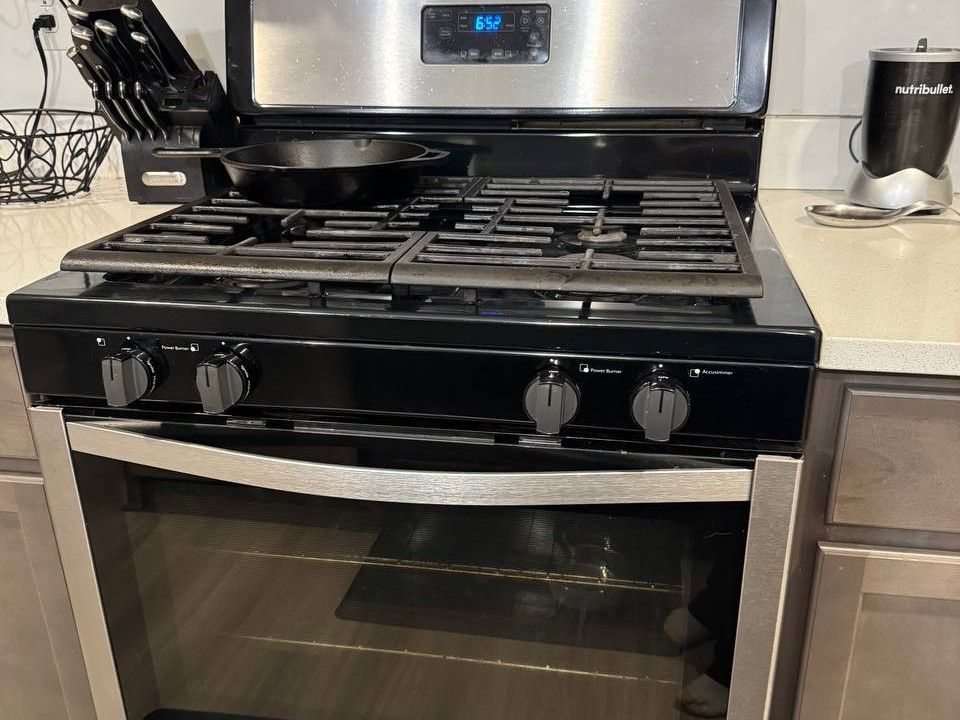
In 2024 the bomb cyclone of November 19 and 20 cut power to about 43,000 Seattle City Light customers, roughly a week before Thanksgiving. That pairing is a good picture of how ranges fail in Shoreline. Electronics take a hit when power comes back unevenly, and the damage often shows up days later, when the oven is asked to hold temperature for hours. A bake igniter that has been weakening for months behaves the same way, heating fine for a quick sheet-pan dinner and giving up halfway through a long roast. When an oven quits at the worst moment, the cause has usually been building for a while.
We repair gas and electric ranges, wall ovens and cooktops, freestanding or slide-in. Your technician tests the supply at the outlet or junction box first, then the parts that fail most: igniters, elements, temperature sensors, surface burner switches and control boards. Many of those ride in the vehicle. If the trouble turns out to be the house wiring or the gas piping rather than the appliance, we stop, explain what we found and tell you which trade to call.
What you seeGas oven takes ages to preheat or never lights
Likely causeBake igniter too weak to open the gas valve
What we doMeasure the igniter's current draw and replace it
What you seeSurface burner clicks and clicks but won't catch
Likely causeWet or cracked spark electrode, or a stuck switch after a spill
What we doDry and clean the burner, then replace the electrode or switch
What you seeElectric oven heats only from the top
Likely causeBake element burned open, often with a visible blister
What we doReplace the element and confirm both legs of power at the terminal
What you seeFood burns at a setting that used to work
Likely causeTemperature sensor drifting out of range
What we doTest the sensor against its chart and replace or recalibrate
What you seeDisplay dark or an error code after an outage
Likely causeControl board or relay damaged when power returned
What we doCheck the supply, test the board and replace what failed
What you seeCoil burner glows red on every setting
Likely causeFailed infinite switch or a burned receptacle block
What we doReplace the switch or block and check the wiring inside the cooktop
Gas cooking is common here because the gas is already in the street. Puget Sound Energy serves most Shoreline neighborhoods, and about 44 percent of homes heat with gas, so a gas range or cooktop is often the easy choice when a kitchen is redone. Gas ranges are durable, but their ignition parts are not: spark electrodes crack, switches short when a pot boils over, and oven igniters weaken gradually until the safety valve no longer opens. We replace those parts routinely. If you ever smell gas at the range, switch nothing on or off; get everyone out and call PSE or 911 from outside.
Rentals and apartments see a different kind of range. Houses let to students near Shoreline Community College and older apartments along the Aurora corridor tend to have basic electric ranges with coil burners, and those run hard: drip pans overflow, a burner gets left on high, and the receptacle block under a coil burns until the element only works when it is wiggled. The newer townhomes near the light-rail stations lean toward smooth glass cooktops, where a heavy pot dropped on the surface can crack the glass and a failed element sensor can leave one zone dead. We carry the common coil parts and test glass-top elements in place.
The oldest houses raise a power question. Electric ranges in post-war homes sometimes run on original 240-volt circuits whose receptacles have loosened with age and heat. A loose blade can scorch the plug, drop one leg of the supply and leave you with an oven that bakes while half the cooktop stays cold. We test both legs at the terminal block during the diagnosis. Inside the range is our work; the receptacle, breaker and wiring in the wall are for an electrician, and we will tell you if that is where the fault sits.
Oven, range and cooktop repairs start at $255. The table on this page sets out how surface elements, sensors, bake elements, igniters and control boards line up from there. The starting price is a guide only; your technician puts the real number in a written estimate once the $95 diagnostic is done, and that diagnostic is credited to the repair if you approve it.
| Surface element, burner or knob switch | from $255 |
|---|---|
| Oven temperature sensor | from $255 |
| Bake or broil element | from $259 |
| Oven igniter (gas) | from $265 |
| Oven control board | from $279 |
| Diagnostic visit | $95, counted toward the repair |
| Another appliance on the same call | $10 off its diagnostic |
2026 starting prices for Lynnwood and nearby towns. The $95 diagnostic counts toward any repair you approve, and your technician writes the exact figure down before work begins.
A range is mostly a box of replaceable parts, and that is good news for a Shoreline kitchen. Igniters, elements, sensors, switches and most control boards can be swapped without moving the counter or the cabinets, so repair usually beats replacement on any unit whose oven cavity and door are in good shape. Gas ranges especially tend to outlive their ignition parts several times over. Replacement starts to make sense when a glass cooktop has cracked on a budget model, since the glass alone can approach the price of a basic new range, or when the oven liner is rusting through, or when a discontinued control board can no longer be found. On a rental, a landlord may also prefer one predictable replacement over repeated coil repairs. We list the repair price in writing and say which way we would lean, and why.
It usually means moisture or a spill reached the spark switch or electrode, and it is more nuisance than hazard as long as there is no gas smell. Let a wet burner dry for a day before using it. If the clicking continues, the switch or electrode needs replacing. If you smell gas at any point, leave the house and call PSE or 911 from outside.
Yes. We repair the radiant elements, limiters, switches, controls and hot-surface lights under the glass. A cracked glass top can be replaced too, but it is usually the most expensive single piece of the cooktop, so we price it first and tell you whether a new cooktop or range would make more sense for your model.
The usual culprit is one failed element: many ovens preheat with both bake and broil, and if one is open the other has to do the work alone. A drifting temperature sensor or a lost leg of the 240-volt supply can do the same. Check that the range breaker is fully on, then book a visit and tell us what you see.
Yes. Wall ovens, double ovens and drop-in or slide-in cooktops get the same diagnosis as ranges, and most of their parts are reachable without pulling the unit far from the cabinet. Read the model number to us when you book; on most units it is printed on a plate along the door frame or under the cooktop.
Look at the breaker first; ranges sit on a double breaker that can trip when power is restored. Reset it once. If the display stays dark or shows an error code, note the code and read it to us when you call or type it into the booking form. Please don't keep cycling the breaker, which can make a damaged board worse.
Something not working?
Phone (425) 287-5458 or book online for range, oven or cooktop repair in Shoreline. The $95 diagnostic is credited to any repair you approve, and seniors 65+, veterans and military households get up to $18 off that repair.
Ovens & ranges
Pies browning on the bottom or roasts running late? Test oven temperature with a thermometer, use the offset setting, and know when a part is really to blame.
Book a repair
Three quick steps. We call back to confirm a time; requests that come in during the morning can usually be seen the same day.
Rather call? (425) 287-5458 · Mon–Sat 8–7