Ovens & ranges
Oven temperature off? Test it before the holiday baking starts
Pies browning on the bottom or roasts running late? Test oven temperature with a thermometer, use the offset setting, and know when a part is really to blame.
Ranges, ovens & cooktops · Kenmore
Burners that click without lighting, an oven that never reaches temperature, a glass cooktop with one dead zone: we repair Kenmore ranges, wall ovens and cooktops, gas and electric, and put the price in writing before touching a screw.
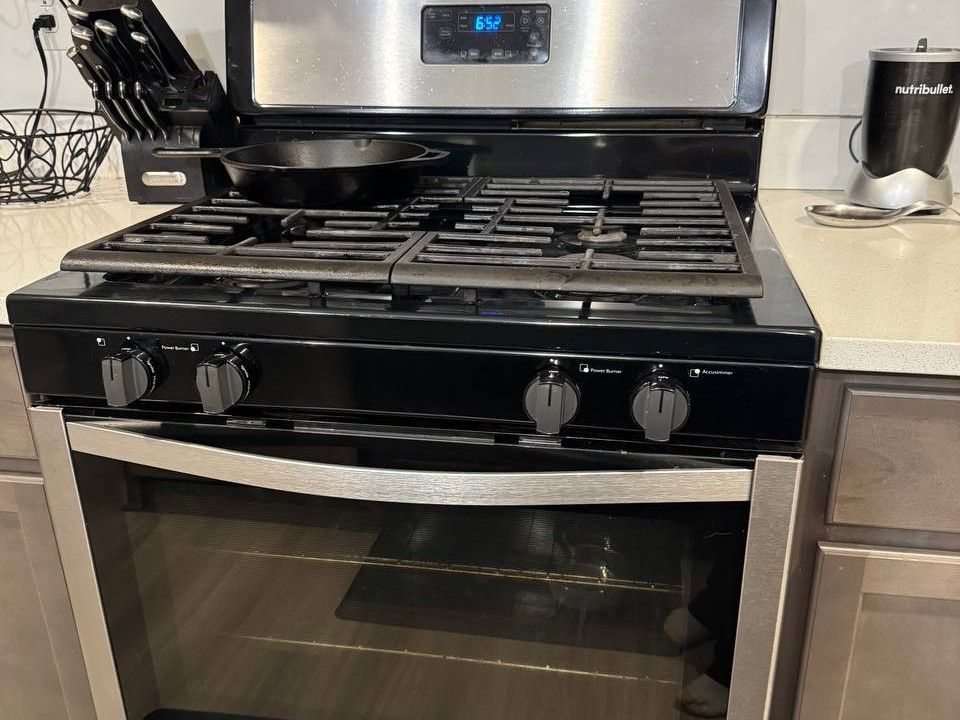
In a town where nearly half the homes heat with natural gas, gas ranges make up a large share of our Kenmore oven calls. The most frequent one is an oven that preheats more and more slowly and then stops lighting altogether. On most gas ranges the bake burner relies on a glowing hot-surface igniter, which weakens with age until it no longer draws enough current to open the gas valve. The broiler may still light and the cooktop works fine, while the oven just sits there cold. That igniter is a part we keep in the vehicle for exactly this reason.
Electric ranges and wall ovens bring a different list: bake elements that burn through with a visible blister, temperature sensors that drift, coil-top surface elements that fail at the receptacle, and glass-top zones run by an infinite switch. Kenmore-label ranges with a 790 prefix are Frigidaire-built, and their parts are easy to source. We also test the outlet and breaker in every older kitchen, because a range that heats weakly can have a supply problem rather than a range problem.
What you seeGas oven won't light, cooktop fine
Likely causeWeak bake igniter no longer opening the gas valve
What we doMeasure the igniter's current draw, replace it, run a bake test with a thermometer
What you seeBurner clicks and won't stop
Likely causeSpark switch wet from a boil-over, or a cracked electrode
What we doDry or replace the switch, check the spark module and electrodes
What you seeElectric oven won't heat or heats slowly
Likely causeBurned-out bake or broil element
What we doInspect and meter both elements, replace the failed one, and check its terminals for heat damage
What you seeFood burns or stays raw at the set temperature
Likely causeTemperature sensor out of range, or a control needing calibration
What we doCheck the sensor's resistance, replace it, verify against a thermometer
What you seeOne coil or glass zone dead
Likely causeInfinite switch, element or coil receptacle
What we doTrace the circuit from switch to element, swap a coil into a known-good socket, replace the failed part
What you seeDoor locked after self-clean, or error codes
Likely causeLock motor, door switch or control board
What we doRelease and test the lock, read the codes, replace the part at fault
Kenmore's oldest streets, Inglewood from 1953 and Uplake Terrace from 1954, hold kitchens that have been remodeled around their original wiring. A new electric range plugged into a decades-old circuit can show weak heat, a breaker that trips under load, or a scorched receptacle hidden behind the range. During diagnosis we measure voltage at the outlet and look over the cord and plug. If the fault lies in the wall or the panel, that is an electrician's job, and we say so before anyone spends money on range parts; if it lies inside the range, it's ours.
PSE supplies both gas and electricity across Kenmore. A gas range should never smell of gas beyond a brief whiff while a burner lights. If the smell lingers, switch nothing on or off, walk out of the house and phone PSE or 911 from the street. Once the utility has cleared it, we can come back for the burners, igniters, valves and controls. Short of a smell, uneven or yellow flames usually mean a burner cap sitting crooked or ports clogged by a spill, which we clean and reseat. Whenever a range comes away from the wall, we also check that its anti-tip bracket is there, since older installs often skipped it.
Kenmore's later subdivisions, from the 1980s and 90s, often pair a cooktop on the island with a wall oven, sometimes a double, set in a cabinet tower. Wall ovens fail the same ways ranges do, but they are heavy and fitted to the cabinetry, so we protect the trim and slide them out on a mat. Many double ovens run both cavities from one control, so a single failure can knock out both; we test each element and sensor on its own before deciding the board is to blame. If yours has been limping along, book before the holidays; a weak igniter or tired element that struggles through October tends to give out on the busiest cooking day of the year.
For ranges, ovens and cooktops, repairs start at $255, and the table below lists the usual jobs in order. Those figures show where pricing begins, not what your repair will come to. After the $95 diagnostic, your technician gives you a written estimate for the actual fault, and once you approve it, the diagnostic is folded into that repair. If the dishwasher next to the range needs a look on the same visit, its diagnostic is $10 less. A household with a senior 65 or older, a veteran or an active-duty service member can take up to $18 off the repair, though never off the diagnostic.
| Surface element, burner or knob switch | from $255 |
|---|---|
| Oven temperature sensor | from $255 |
| Bake or broil element | from $259 |
| Oven igniter (gas) | from $265 |
| Oven control board | from $279 |
| Diagnostic visit | $95, counted toward the repair |
| Another appliance on the same call | $10 off its diagnostic |
2026 starting prices for Lynnwood and nearby towns. The $95 diagnostic counts toward any repair you approve, and your technician writes the exact figure down before work begins.
Most range repairs are small next to the price of a new range: an igniter, an element, a sensor or a spark switch. Built-in wall ovens and island cooktops tilt even further toward repair, since replacing one means matching a cutout in the cabinetry, and standard sizes have shifted over the years. The case for replacing grows when an older range needs a control board that is no longer made, when the oven cavity's enamel is cracked or rusting through, or when a gas range's valves and burners are all worn at once. In Kenmore's 1950s and 60s kitchens, some owners treat a failing range as a reason to rethink the whole layout; if you're leaning that way, we will tell you whether the current unit deserves a repair to carry you through the planning.
Very likely. A hot-surface igniter has to glow hot enough, and pass enough current, to open the oven's gas valve. As it ages it still glows but takes longer to reach that point, so preheat stretches out and the oven may shut off mid-bake. Your technician measures the current draw, which settles the question in a few minutes, and carries the common igniters.
Yes. Radiant glass tops and induction cooktops are household appliances we work on. A dead zone usually comes down to an element, a switch or a control, and induction faults are more often electronic. A cracked glass top is a different matter: replacement glass can cost enough that we price it against a new cooktop so you can compare.
No. Microwaves, including over-the-range models, are outside what we repair, and so are toaster ovens and other countertop appliances. We focus on the range, the wall oven and the cooktop. If a wall unit combines a microwave with an oven and the fault is in the oven half, describe it when you call and we will tell you whether it is something we can take on.
It is designed to be safe, but the cycle drives the oven far hotter than cooking does, and that heat finds weak parts: thermal fuses, door locks, sensors and boards. On an older or troublesome range, clean by hand instead, especially in the weeks before a holiday. If the door stays locked after a cycle, let the oven cool completely, then call us.
It can be either. A shorted element or a burned terminal block inside the range will trip a healthy breaker, but so can a loose or overheated connection at the outlet or a weak breaker in an older panel. We test the range and the supply during the diagnostic. Faults inside the range we fix; faults in the wall or panel go to an electrician, and we tell you which it is.
Something not working?
Call (425) 287-5458 or book online to have a Kenmore range, oven or cooktop looked at, Monday through Saturday. The $95 diagnostic is credited when you approve the repair, and seniors 65+, veterans and active-duty military households save up to $18 on that repair.
Ovens & ranges
Pies browning on the bottom or roasts running late? Test oven temperature with a thermometer, use the offset setting, and know when a part is really to blame.
Book a repair
Three quick steps. We call back to confirm a time; requests that come in during the morning can usually be seen the same day.
Rather call? (425) 287-5458 · Mon–Sat 8–7