Ovens & ranges
Oven temperature off? Test it before the holiday baking starts
Pies browning on the bottom or roasts running late? Test oven temperature with a thermometer, use the offset setting, and know when a part is really to blame.
Ranges, ovens & cooktops · Lynnwood
Lynnwood cooks on everything: coil ranges in 1960s ramblers, wall ovens in 1970s split-levels, gas ranges where PSE runs a line, and glass tops in the new apartments by the station. We repair all of them.
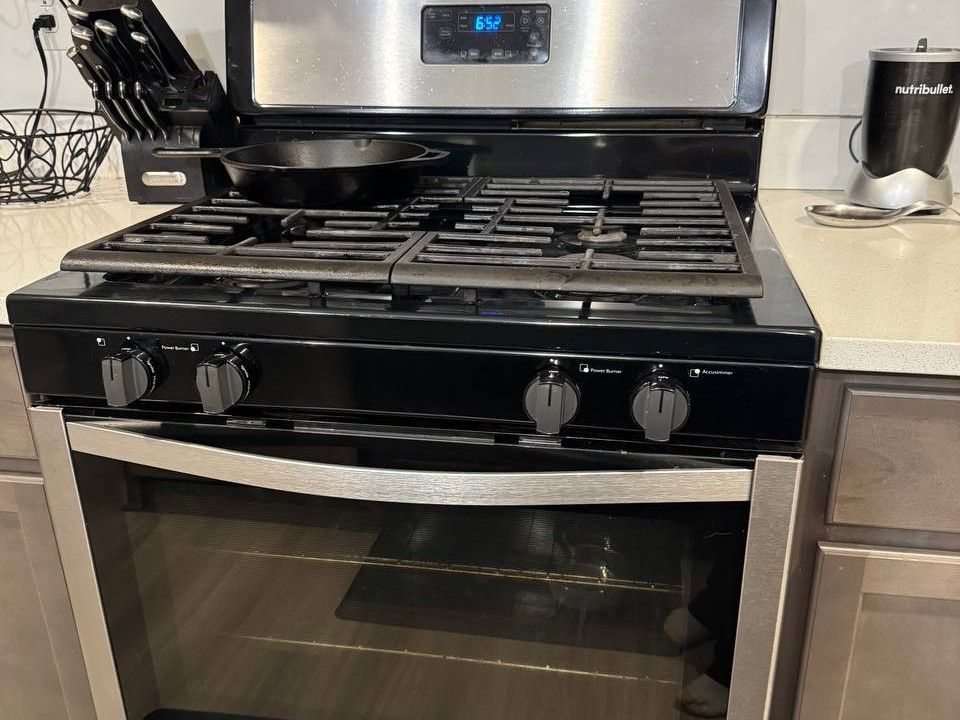
Ovens work hardest in Lynnwood through the darker half of the year, and that is when bake elements, igniters and self-clean cycles tend to give out. The usual sequence is familiar to anyone who has hosted a holiday dinner: the oven gets a self-clean the day before, locks itself, runs extremely hot for hours, and afterward the door stays locked or the oven will not heat at all. A thermal fuse, a door-lock motor or a relay on the control board has given up under the strain, usually at the least convenient moment.
Lynnwood kitchens bring their own variables to that. Many houses from the 1960s and 70s still have a built-in wall oven and a separate cooktop set into cabinet openings sized for models nobody makes anymore. Newer apartment kitchens around the station and up in North Lynnwood carry smooth-top and induction ranges with touch controls that are sensitive to the quality of the power reaching them. And gas ranges, where a house has a line, call for a technician who checks the igniter and the flame, not only the clock. On those, the first warning is usually an oven that takes longer and longer to light before it stops lighting at all.
What you seeOven stays cold while the broiler still works
Likely causeBake element burned through, often with a visible blister or split
What we doConfirm it with a meter, replace the element and clean up its terminals
What you seeDoor stuck locked after self-clean
Likely causeLock motor, lock switch or a tripped thermal fuse
What we doRelease the latch safely, test the lock circuit and replace the failed piece
What you seeTemperatures wander or a sensor code appears
Likely causeOven sensor or its connector failing
What we doTest the sensor against its rated resistance and replace it if it reads out of range
What you seeGas oven slow to light, or not lighting at all
Likely causeWeak hot-surface igniter no longer drawing enough current to open the valve
What we doMeasure the igniter's draw, replace it, then check the bake flame
What you seeCoil burner works only on high, or not at all
Likely causeBurned receptacle or a worn infinite switch
What we doReplace the receptacle or switch and inspect the wiring behind it
What you seeTouch panel dark or beeping after the power came back
Likely causeControl board or keypad damaged by a surge
What we doTest the supply, the keypad and the board, and replace only what failed
Wall ovens were a fixture of the kitchens built during Lynnwood's 1960s and 70s growth, and plenty survive in Cedar Valley, Lynndale and Meadowdale houses. The challenge with them is replacement rather than repair: cutout sizes from that era do not always match what is sold now, and 27-inch wall ovens in particular come in only a handful of current models. Keeping a sound older oven going with a new element, sensor or thermostat is often the more sensible use of money than rebuilding a cabinet around a new one.
Ranges pull more power than anything else in the kitchen, so in older houses the receptacle, the cord and the breaker are part of every diagnosis. A range whose surface elements work while the oven barely warms may be missing one leg of its 240-volt supply. We measure that before touching a part. If the fault is in the house wiring, we describe what we measured so an electrician can pick it up; everything from the cord inward is ours. The coil-top ranges in those houses are among the simplest appliances we repair: a burned coil, a scorched receptacle or a worn infinite switch can usually be swapped in one visit, and the parts are common across brands such as GE, Hotpoint, Whirlpool and Frigidaire.
When the November 2024 bomb cyclone left a large slice of the PUD's territory dark, the flickering return of service was hard on electronics. Ranges with glass touch panels, convection fans and digital clocks were among the appliances that came back with blank displays or phantom beeps. A board is not always the answer, though. Sometimes it is a tripped breaker, a loose keypad ribbon or a door switch, and we test those first. If your range acts oddly after any outage, flip its breaker off, wait a minute, then restore it; a control that wakes up normally after that reset may need nothing more.
Oven and range repair starts at $255, which covers surface elements, sensors, bake elements, igniters and control boards on gas and electric models. Consider it the low end of the category, which is different from a quote: the exact amount reaches you in writing after the $95 diagnostic, and that estimate is what you approve or decline. We do not work on microwaves, including the over-the-range kind, or on countertop ovens, and we say so before you book.
| Surface element, burner or knob switch | from $255 |
|---|---|
| Oven temperature sensor | from $255 |
| Bake or broil element | from $259 |
| Oven igniter (gas) | from $265 |
| Oven control board | from $279 |
| Diagnostic visit | $95, counted toward the repair |
| Another appliance on the same call | $10 off its diagnostic |
2026 starting prices for Lynnwood and nearby towns. The $95 diagnostic counts toward any repair you approve, and your technician writes the exact figure down before work begins.
A range or wall oven with a failed element, igniter, sensor or switch is almost always worth repairing, because the cabinet, the insulation and the door outlast those parts by a wide margin. In Lynnwood's older split-levels, the built-in question tips things further toward repair: a working 27-inch wall oven with one bad element is worth far more in place than the cabinetry it would take to fit a new one. The balance shifts when a newer electronic range needs a control board and a keypad together, or when a smooth-top has a cracked glass surface and a failed element at the same time. On a basic 30-inch range in a City Center rental, a full replacement can be simpler for the owner than a second repair within a year. We lay out the estimate and our view, and you choose.
Do not light anything or flip switches. Leave the house with everyone in it, and from outside, call PSE or 911. They will find and stop the leak. Once the gas side has been made safe, book a visit and your technician can look at the burners, igniters, valves and controls on the range itself and repair whatever caused the trouble.
It is safe in the sense that the oven is designed for it, but self-clean is the hardest thing you can ask of an oven. It runs very hot for hours, and fuses, lock motors and boards that are already tired often fail during it. On an older oven, wiping spills regularly and cleaning by hand is gentler. If you do run it, avoid the days right before a holiday meal.
Yes. Wall ovens slide out of their cutouts once the mounting screws come out, and most elements, sensors, locks and boards can be replaced on the spot. The model number is stamped on the frame behind the door; read it to us when you book, so we can check the parts ahead of time. Double wall ovens are heavy, so your technician may need a clear path in front of them.
Yes. Induction units fail in their own ways: a zone that flashes and will not heat, a cooling fan that has seized, or a power board that has quit. We test with a known magnetic pan first, since a pan that will not hold a magnet will not heat on induction. Then we check the coils, the fans and the boards and replace what failed.
A clock that blinks or resets means the range lost power for a moment, perhaps during a storm or a tripped breaker. Many ranges need the clock set again before they will bake. If the clock is set and the oven still will not heat, or the display is blank, the problem may be the control board, a fuse or the supply, and a visit is the next step.
Something not working?
Phone (425) 287-5458 or book online, and tell us whether your range runs on gas or electricity. The $95 diagnostic counts toward any oven or range repair you approve, while seniors over 65, veterans and military households can knock up to $18 off it.
Ovens & ranges
Pies browning on the bottom or roasts running late? Test oven temperature with a thermometer, use the offset setting, and know when a part is really to blame.
Book a repair
Three quick steps. We call back to confirm a time; requests that come in during the morning can usually be seen the same day.
Rather call? (425) 287-5458 · Mon–Sat 8–7